Indoor rowing has long been a useful option to work out without being dependent on weather, traffic, or outdoor conditions. Traditional rowing machines can be tough to work out on, but the latest connected models add a new dimension: they can track performance, guide structured sessions, show workout data, and sometimes connect users with digital classes or training programs. These elements can also influence the way a person tackles an indoor workout, especially when motivation or consistency is challenging.
But connectivity doesn’t make a rowing workout better. A machine can have great figures, but the user may not know what they mean or how to use them. The true trick is turning raw information into constructive feedback. Stroke rate, pace, distance, heart rate, duration of workout, and training history can all assist users in seeing how they are doing and if they are exercising more consistently. In this article, we will explain how linked rowing machines work, which features are actually important, where they can improve indoor training, and what beginners should consider before they get too reliant on technology.
What is a Connected Rowing Machine?
A connected rowing machine is a rowing machine that can communicate with digital devices, software, or web services. Depending on the device, the connection may be via Bluetooth, Wi-Fi, a companion app, a built-in touch screen, or some other wireless connection. Exact features vary widely; therefore, “connected” should not be considered a uniform specification.
Some machines merely send data from your workout to a smartphone or tablet. Some have performance dashboards, workout histories, built-in training plans, digital classes, or interactive experiences. Some can link up to external heart rate monitors or fitness platforms. The key difference is between connectivity that simply sends data and connectivity that actively helps shape the workout.
| Connected Feature | What It Can Do | Potential Training Benefit |
|---|---|---|
| Bluetooth connectivity | Connects compatible devices or sensors | Can make workout data easier to view or record |
| Workout tracking | Records distance, time, pace, strokes, or related metrics | Helps users monitor progress |
| Digital classes | Provides guided sessions | Can add structure and variety |
| Performance history | Stores previous workouts | Makes trends easier to identify |
| Interactive training | Responds to programmed workouts or virtual environments | Can make sessions more engaging |
Before choosing a machine, look at the actual features rather than assuming that all connected models offer the same experience. A machine with simple Bluetooth data transmission is very different from one built around an extensive digital training platform.
Why Real-Time Feedback Matters
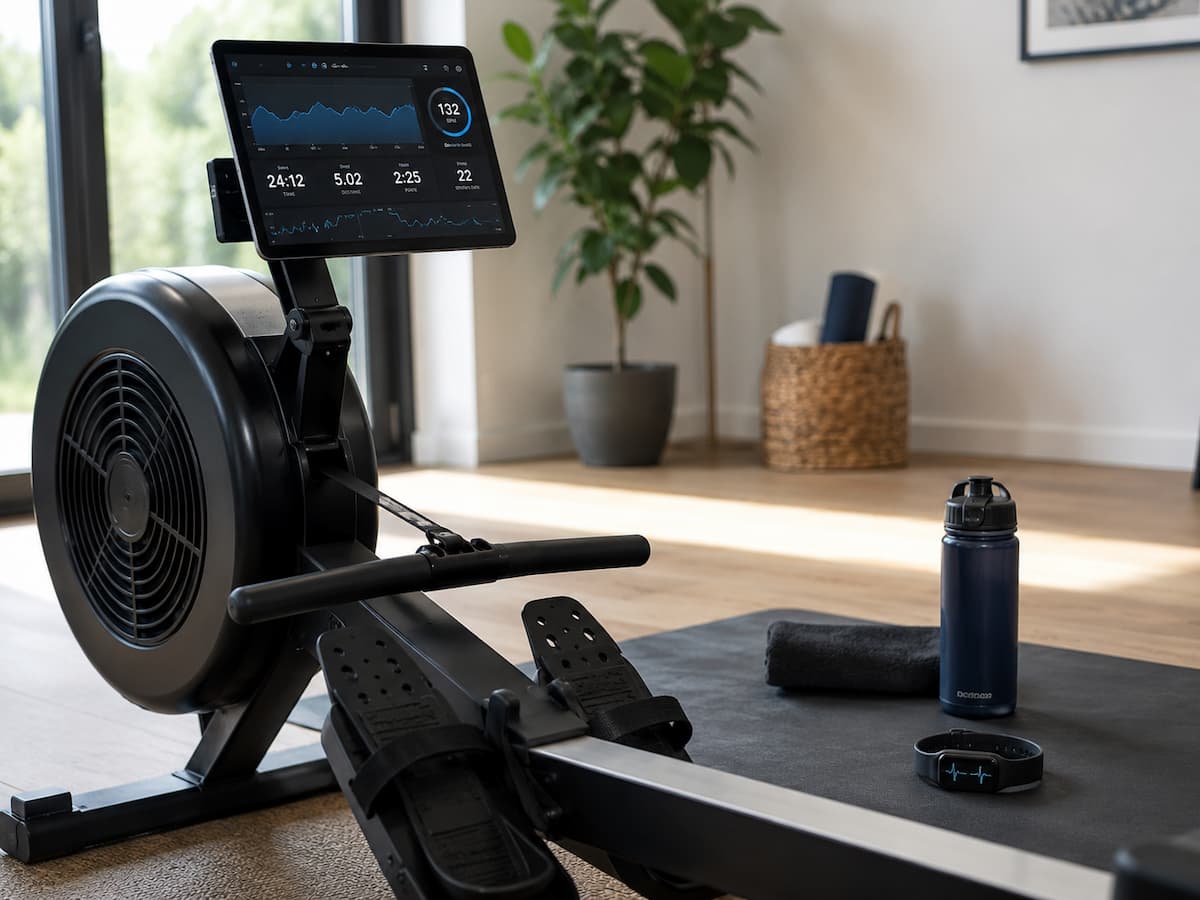
One of the biggest advantages of connected rowing is immediate feedback. During a workout, a user can often see information such as elapsed time, distance, pace, stroke rate, and sometimes additional measurements. This gives the person something concrete to respond to instead of relying entirely on how the workout feels.
For example, suppose you intend to row at a steady effort for 20 minutes. If your pace gradually slows, the display can make that change visible. You can then decide whether you started too quickly, need to adjust your effort, or should simply accept the change because fatigue is expected. Without feedback, the difference between your intended pace and actual pace can be harder to recognize.
Real-time data can also help prevent every workout from becoming an accidental race. Beginners often pull harder because they believe harder automatically means better. A structured session may instead require maintaining a controlled pace for a specific period. The screen can reinforce that target and help the user learn what a sustainable effort feels like.
Structured Workouts Become Easier to Follow
Many people know that interval training can vary intensity, but they struggle to create or follow intervals on their own. Connected rowing platforms can make structured workouts easier by providing instructions, timing intervals, and displaying targets. A session might include a warm-up, several periods of harder rowing, recovery intervals, and a cooldown. Instead of repeatedly checking a clock and trying to remember the next interval, the digital interface can guide the sequence.
This can be particularly useful for people who prefer having a clear objective for each workout. A structured session also makes it easier to compare similar workouts over time. If you repeat a workout after several weeks, you can compare the relevant performance measures and determine whether the session felt easier or your output changed.
Structure without losing flexibility
Guided workouts should not become a reason to ignore how you feel. If a session is unusually difficult because you are tired, returning from a break, or dealing with another factor affecting your training, the appropriate response may be to reduce intensity or stop. A digital target is a training tool, not a requirement to override common sense.
Tracking Progress Over Time
Another important benefit is historical data. A single workout tells you very little about long-term progress. A record of dozens of sessions can reveal patterns that are difficult to remember.
You might discover that your average pace has improved, that you are completing longer sessions, or that your ability to maintain a particular effort has become more consistent. You may also notice the opposite: performance has remained flat despite increasing workout frequency, suggesting that your training plan may need adjustment.
| Metric | Useful Question |
|---|---|
| Distance | Am I completing longer sessions or covering more distance at a similar effort? |
| Time | Am I gradually increasing the duration I can train comfortably? |
| Pace | Is my pace becoming more consistent or improving under comparable conditions? |
| Stroke rate | Am I maintaining an appropriate stroke rhythm for the workout? |
| Heart rate | How does my cardiovascular response compare during similar sessions? |
Comparisons are most useful when the workouts are reasonably similar. Comparing a short interval session with a relaxed endurance session does not tell you much. For meaningful progress tracking, compare like with like whenever possible.
Using Technology to Understand Rowing Technique
Rowing involves more than repeatedly pulling a handle. The movement includes the legs, body, and arms working together in a coordinated sequence. Beginners can sometimes focus so much on the display that they overlook movement quality.
Some connected systems provide technique guidance or visual instruction. These features can help users understand concepts such as sequencing, rhythm, recovery, and posture. However, digital feedback has limits. A screen cannot always identify every technical issue, especially when the machine does not have sophisticated movement analysis.
A useful approach is to use technology for basic awareness while treating technique instruction as a separate learning task. Follow reputable rowing instruction, pay attention to body position, and avoid increasing intensity simply because a metric looks low.
How Connected Features Can Improve Motivation
Motivation is one of the less measurable but potentially useful benefits of connected fitness equipment. A basic rowing machine can provide an excellent workout, but some people find repetitive indoor exercise difficult to maintain. Digital classes, workout targets, progress records, and virtual environments can add variety.
Seeing a training history can also create a sense of continuity. Instead of remembering that you “worked out a lot last month,” you can look at actual sessions and see what you completed. That can make consistency more visible.
However, motivation can work in the opposite direction. Some people become overly focused on rankings, virtual competition, or beating previous numbers. A workout that should have been easy can turn into a hard effort simply because the display encourages comparison. The most useful connected experience is therefore personal. Use digital features to support consistency and enjoyment rather than allowing them to dictate every workout.
Heart Rate and Other Training Data
Connected rowing systems may support heart-rate monitoring through compatible devices. Heart rate can provide additional information about exercise intensity, particularly when combined with the subjective feeling of effort.
For example, two rowing sessions may have the same duration and distance but feel entirely unique. Heart-rate data can provide another point of comparison. However, heart rate is affected by many factors, including temperature, hydration, stress, sleep, fitness level, medications, and measurement quality.
It is therefore better to view heart rate as one piece of information rather than a perfect measure of effort. Wearable devices and sensors can also differ in accuracy depending on the technology and how they are worn. Other data may include stroke count, stroke rate, power, pace, and distance. Not every metric is equally useful for every person. Beginners often benefit from focusing on a small number of understandable measurements rather than trying to interpret a dashboard full of numbers.
Interactive Classes and Training Experiences
Interactive training can change the experience of indoor rowing by giving the workout a stronger sense of purpose. Instead of simply deciding to row for 30 minutes, a user may select a particular class, interval session, scenic workout, or training program.
This can reduce the mental effort required to decide what to do. A guided session tells you when to change intensity, how long an interval lasts, or what the next stage of the workout involves. For someone who finds self-directed training boring, that structure can make indoor exercise easier to maintain.
There is also a social element on some platforms. Leaderboards, classes, challenges, and shared workouts can create a sense of participation even when the person is exercising alone at home. But interactive features are not automatically necessary. If you prefer listening to music and following your own training plan, a simpler machine may provide everything you need. Connectivity should solve a problem you actually have rather than become a feature you pay for but rarely use.
Why Connected Rowing Can Help Beginners
Beginners often face two challenges: not knowing what to do and not knowing whether they are improving. A connected rowing machine can address both problems by providing guided workouts and recording performance information. Instead of randomly changing resistance or rowing as hard as possible, a beginner can follow a structured session designed around time, pace, or effort. Over time, the workout history can provide evidence of consistency and progress.
Still, beginners should avoid focusing entirely on performance numbers. Learning a comfortable rowing rhythm and basic technique should come before trying to maximize output. A lower number does not necessarily mean a poor workout, especially when the session is designed for recovery or endurance.
New users should also learn how the machine measures its metrics. Different equipment and software can present information differently, and a number is useful only when you understand what it represents.
The Limitations of Connected Rowing Machines
Connected technology has clear advantages, but it also introduces costs and complications. Some machines depend heavily on software subscriptions. Others require compatible phones, tablets, heart-rate sensors, or stable internet connections for certain features.
Software can also change. Features may be updated, redesigned, moved behind subscriptions, or discontinued. A machine that looks impressive because of its current digital platform should therefore be evaluated as both fitness equipment and technology.
| Potential Advantage | Possible Limitation |
|---|---|
| Detailed workout data | Too much information can become distracting. |
| Guided classes | Some platforms may require subscriptions. |
| Progress history | Data may depend on software compatibility. |
| Interactive experiences | Requires more technology than a basic rower |
| Connected sensors | Wireless devices may occasionally lose connection. |
There is also a basic training limitation: technology cannot replace consistency. A connected machine sitting unused does not provide a training benefit simply because it has advanced features.
What to Look for in a Connected Rowing Machine
If you are considering a connected rowing machine, start with the rowing machine itself rather than the software. The machine should provide a suitable fit, comfortable movement, appropriate resistance, stable construction, and a display you can actually read during training.
Then evaluate the connected features. Determine which metrics are available, how workout data is stored, whether external devices are supported, whether internet access is required, and whether important features depend on a subscription.
Questions worth asking before buying
- Does the machine provide the performance metrics I actually want?
- Can I use it without a subscription?
- What happens if the internet connection is unavailable?
- Can workout data be exported or synchronized?
- Does it support compatible heart-rate monitors?
- Is the display easy to read while rowing?
- Does the machine fit my available space?
- Is the rowing motion comfortable for my body?
- What happens if the connected software is discontinued?
A machine with fewer digital features may be the better choice if its core rowing experience is stronger and the additional technology does not solve a real need.
How to Get More From Connected Indoor Training
The best way to use connected rowing technology is to give each workout a clear purpose. One session might focus on easy endurance work, another on intervals, and another on technique or recovery. The display can then provide information that matches the goal instead of becoming a constant stream of numbers.
Record workouts consistently, but avoid judging every session in isolation. Performance varies from day to day. Look for longer-term patterns rather than treating one unusually strong or weak workout as a major development.
It is also useful to schedule occasional sessions without chasing performance. A relaxed row can help you practice rhythm and technique without worrying about a personal record. Connected technology should expand your training options, not turn every session into a competition.
- Choose a clear purpose for each workout.
- Use only the metrics relevant to that purpose.
- Compare similar workouts rather than unrelated sessions.
- Keep technique and movement quality ahead of performance numbers.
- Review longer-term trends periodically.
- Use guided workouts when you need structure.
- Train without competitive features when they become distracting.
Conclusion
Connected rowing machines make workout information, organized sessions, and progress easier to monitor and track. These elements can make indoor rowing more entertaining and structured for individuals who struggle with motivation, planning, or performance tracking.
Technology works best when it complements a training aim. Real-time analytics can help you manage effort, workout histories can reveal long-term patterns, and guided sessions can simplify structured training. However, connectivity should not interfere with technique, consistency, or training selections.
Examine a connected rowing machine beyond the screen and software. Consider rowing quality and comfort, metrics you need, subscription requirements, compatibility, data access, and technology longevity. The most feature-rich rower may not be the best connected. Their qualities make indoor training easier to understand, follow, and sustain.
FAQs
1. Which rowing machine is connected?
Indoor rowing machines connect with digital devices, apps, sensors, or online training platforms. It may track workouts, offer guided classes, save training history, or connect to heart-rate monitors, depending on the model. Connectivity varies widely between machines. Some transmit data via Bluetooth, while others have interactive training systems. Therefore, check the features rather than assuming every connected rowing machine offers the same experience.
2. Are connected rowing machines more effective than basic ones?
Not automatically. A simple rowing machine can work out well without accessories. Connected models offer advice, feedback, tracking, and interactivity. These characteristics can help someone train more consistently or follow scheduled sessions, but they cannot substitute solid technique or frequent exercise. If you prefer self-directed rowing without digital feedback, a simpler machine may work.
3. Should I subscribe to connected rowing machines?
It depends on the hardware and software. Some linked rowers offer basic workouts without a membership but charge for additional classes, training programs, or interactive features. Others may have subscription-based ecosystems. Before buying, check which functions are available without a subscription. This feature is crucial if you want performance tracking instead of a massive digital class library.
4. Beginners should focus on what rowing metrics?
Beginners probably don’t need to track every statistic. Exercise duration, pace, distance, and stroke rate can provide useful data, but heart rate can add another perspective when recorded properly. The optimal workout metric depends on its goal. In an easy session, controlled effort may be more important than distance. Understanding a metric is more important than measuring several things.
5. Could linked rowing replace outdoor exercise?
Depending on goals, connected indoor rowing can replace outdoor aerobic and muscular exercise. Outdoor activities offer varied movements, settings, and experiences. Indoor rowing helps when weather, time, location, or convenience make outside training problematic. It can supplement other exercises rather than replace them. Different training routines have physical and practical benefits.

Ethan Caldwell is a wellness technology researcher and lifestyle writer focused on the intersection of health, innovation, and everyday wellbeing. He specializes in topics such as fitness technology, sleep optimization, AI-powered nutrition, workplace wellness, and mental health strategies. Through extensive research and analysis of emerging health trends, Ethan creates practical, easy-to-understand content designed to help readers make informed decisions and build healthier daily habits. His goal is to translate complex wellness concepts into actionable guidance for modern living.